Offerings for the deities and its taboo

Image hosted by Photobucket.com

Many Penangites are Taoists. Therefore, when they have prayers, there are many things to observe. For e.g. the kind of cakes offered to the deities have their own significance. And fruits also carry some special meaning.

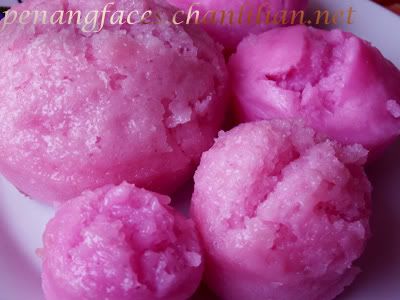
The above is a plate of huat kueh (in Hokkien) which means prosperity cakes. It is a must when offering to the deities as it signifies prosperity to the devotees. There is another type of kueh, call the angkoo (red turtle) which I hope to show one day. When offering angkoo, the devotees will chant something like ‘pai angkoo, beh hui khoo’ (offer angkoo, the descendants/devotees buy properties, it rhymes, you see?).

As for fruits, sometimes, family members can go into feud if one party offered the wrong kind of fruits. For e.g. pears. It sounded like ‘scrap’ in Hokkien. Therefore, if say, the daughter offered pears to the ancestors, the son may accused the sibling of trying to scrap all the properties from their ancestors. So, only certain fruits like pineapple (ong lai = prosperity come), apple (pheng koh = fair and harmonious) and oranges (like gold) are permitted. Another best to avoid furit is the yellow China pear called ‘lai’ which sounds like ‘come’. This also can be construed as one party trying to call all the luck to their side. Even grapes are not permitted as it sounds like a saying, ‘pai phor tho, ju sui ju bo’ (like grapes, the more you count, the more there is none).

*The owner of this blog is a Catholic. The above are just mere information which she had learnt from her past family traditions. What was mentioned above is not mere jokes but real things that had happened especially during Ching Ming where the descendants are gathered together for prayers.

Posted by on April 12th, 2005 under Festivals & Religious


No Responses to “Offerings for the deities and its taboo”

  1. Dhana Says:

    Diverging from the main idea of your post-isn’t there a shop near Komtar which sells huat kueh in various shapes and colors. I recall turtle shaped huat kuehs especially. I used to always want to try them just because of the shape.

  2. lilian Says:

    Dhana
    I think you mean the bun type? That one is called mee-koo. It is sort of like bread, ya? The shop is still there, selling the purportedly best one in town.

    This huat kueh is made from coconut milk and some tuak to make it rise.

  3. pompit Says:

    Lil, forgive me for this very naive or some what silly question but what happens to the food/fruit after it has been “offered”? When and why do u actually take it away?

  4. lilian Says:

    Hi Pompit
    Interesting question.

    Usually, if we are offering to the ancestors, we will use two coins and then ask the ancestors if they are here to eat yet. If the coin has head and tail, it means yes. If no, then we wait. Sometimes, probability punya pasal ke, really superstituous punya pasal, the family may not get a head/tail combination so easily. But it is not ‘polite’ to throw the coins so many times, kan? So, the family members will see if they missed serving the ancestors favourite food or something.

    So, when they get the ‘yes’ signal, they will wait for a while, the time we take to eat la, katakan. Then, they will throw the coins and ask if the nenek-moyang dah makan kenyang. If get yes, then simpan.

    But if they sembah to the deities, usually, they don’t ask la. Just give an estimated time that people eat a meal. However,if just fruits and kueh, then some family left the thing there for a day or two (and throw away the kueh basi).

    I must add – usually, Christians are not encouraged to partake in these kind of foods because we do not want to confuse people that by eating, we are believing in the deities etc. Which of course, is sinful as we believe only in God. But most of us do eat the food offered to the ancestors ‘cos to us, it is just food. Nothing lah kan. However, if there is a big public function like the Hungry Ghost festival/Datuk Kong prayers, orang ramai-ramai, then I will stay away from joining in the makan-makan la. ‘Cos in the Bible, we are told not to participate in such things as we do not want people weaker in faith to think that what is being done is what we accept too.

  5. pompit Says:

    Ooooohh .. wow ..interesting .. I never knew all this. I wonder what they used be4 the existence of coins? So many things to ask … Tks for the long explanation …

  6. Ling Says:

    Hi Lilian, I’m extremely interested in the recipe to bake the pak thong kou. By any chance you cud share with me. My little girl likes it a lot & I use to buy them from a near by market. It will be lovely if I cud do it at home for her. There is another “kou” that is flat in shape & pinkish in colour.. it has texture of “pak thong kou” but lot smoother & not as sticky… I do not know exactly what you call it… but the local here call it the “hei peng”… It will be great if you know how to that too… Rgds Ling

Recent Posts